
Drugs Used for Treatment of Prostate Cancer
The following are tables that list the main drugs used to treat prostate cancer in Canada, the United States, the United Kingdom, and Australia.
Adapted from: Wassersug, R. J., Walker, L. M., & Robinson, J. W. (2023). Androgen deprivation therapy: An essential guide for prostate cancer patients and their loved ones (3rd ed, European ed.). New York: Demos Health.
*Last updated April, 2023. Please contact lifeonadt@gmail.com if you notice any errors.
2026 Update: Results from the PATCH/STAMPEDE Randomized Trial (Langley et al., 2026) show that transdermal estradiol (tE2) offers cancer control equal to that of traditional ADT (with LHRH agonists, such as in the table below), with better effects on quality of life. For more information, please visit the Estradiol Initiative website at: https://estradiolinitiative.org/
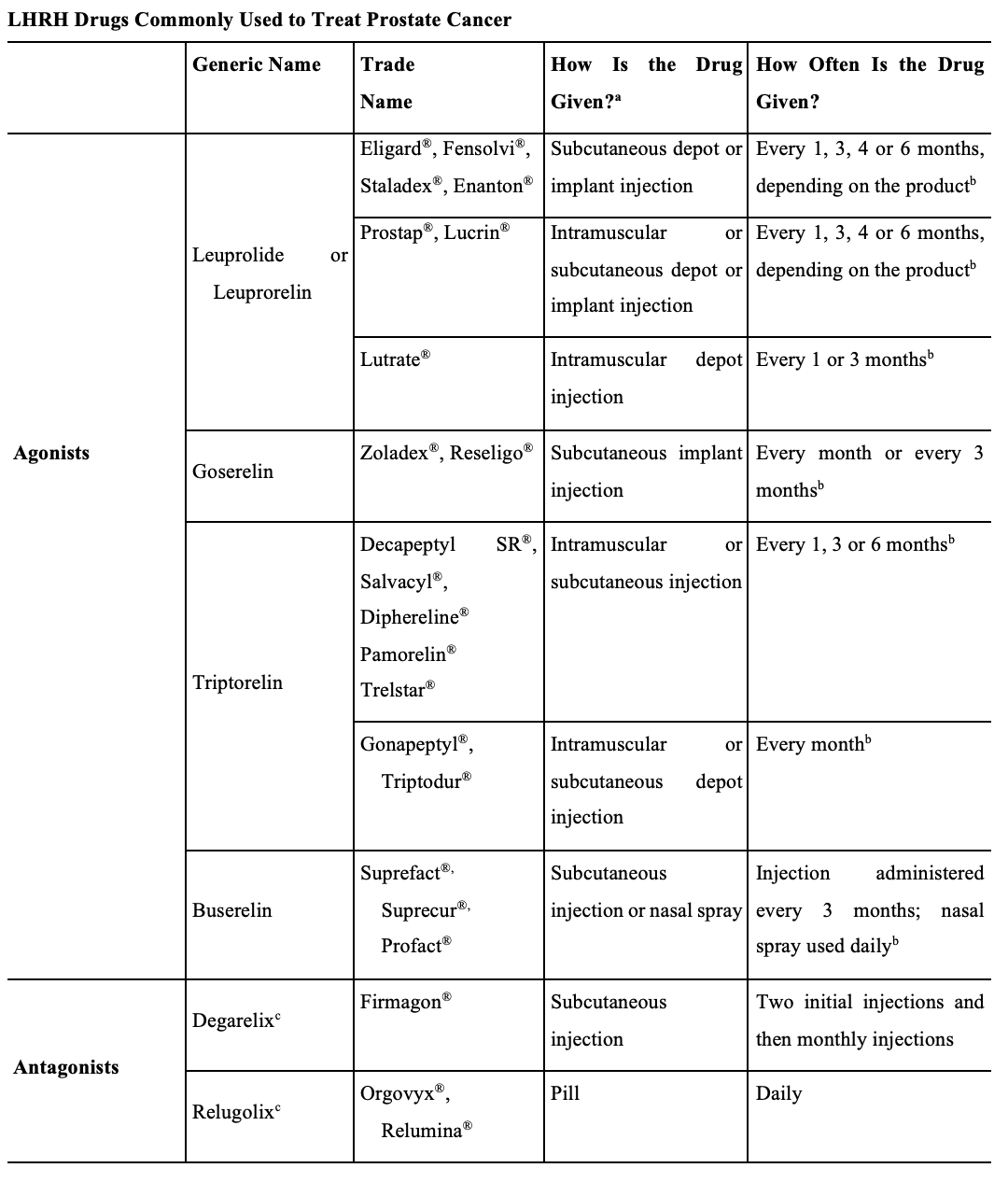
LHRH = luteinizing hormone-releasing hormone.
aSubcutaneous injections are given under the skin, usually in the abdomen. Intramuscular injections are usually injected into the buttock.
bFrequency of injections depends on the dose.
cUnlike the other drugs listed here, degarelix and relugolix are LHRH antagonists rather than LHRH agonists.
Note: Not all drugs are authorized in all countries. The dosage and location of injection may vary between drugs, but the long-term side effects are largely similar whether the drugs are agonists or antagonists. After the injection is administered, you may feel tenderness and/or itchiness and a small lump under the skin at the injection site.

